Heroic Waste Management → Made Easy
Waste Stream Separation
Crews sort trash, recycling and organics by hand at your Northern California apartment community six days a week, catching contamination before the hauler photographs it.
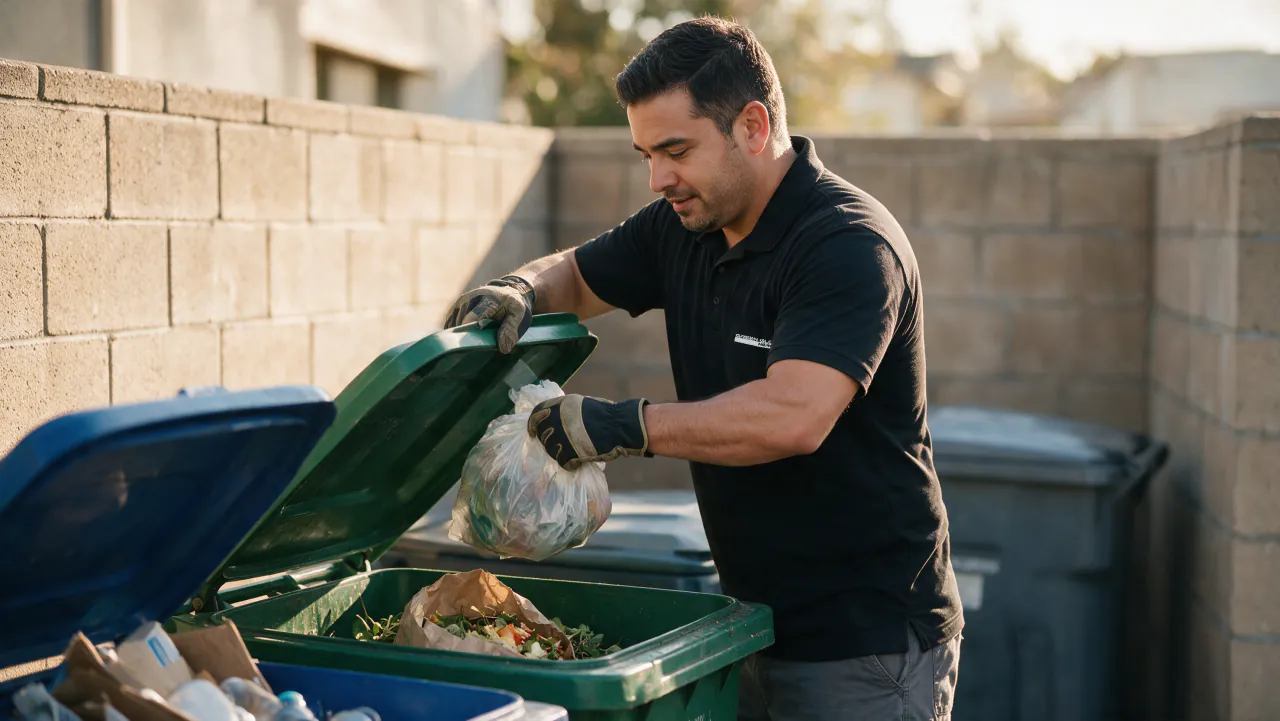
Every stream sorted by hand
Waste stream separation is the physical work of sorting a property's trash, recycling, and organics into the correct containers and removing contaminants before collection. Green Glove Heroes crews do it by hand six days a week at multifamily properties across Northern California, and we time it to the hauler's pickups. You'll see that work in your contamination fees and your diversion rate, and in your SB 1383 compliance.
Somebody has to physically do it
Residents sort at the kitchen counter and don't always get it right, and then the hauler collects and photographs whatever is in the container. The enclosure sits in between, and that's where a bag of trash in the recycling turns into a fee unless somebody takes it out. Our porters do that Sunday through Friday.
What separation involves
Our porters open every container and look inside. Anything in the wrong stream gets pulled and moved where it belongs. They break down cardboard, and plastic stays out of the organics. Bulk comes out of the containers and gets staged, then lids, labels, and positions get reset before anyone takes the photo.
Timed to the truck
Sorting on Tuesday won't help with a Monday pickup, so we schedule our visits to your hauler's route and the containers are clean when the camera sees them.
Compactors make separation impossible
Once trash goes into a compactor, nobody can sort it, because it's one compressed stream that the truck reads as contaminated. That means properties with compactors carry more contamination exposure by design. Compactor Maintenance
The data is a byproduct
When we look inside every container six days a week, we learn which building, floor, and stream is causing the problem. You can request contamination reports from us, and we use them to guide training and program changes.
What the city is looking for
Under SB 1383, your jurisdiction checks contamination two ways. Route reviews mean someone looks inside randomly selected containers at least once a year. Waste evaluations sample loads twice a year, and if a container type runs more than 25% contamination, the jurisdiction notifies and educates the properties on that route. More haulers also photograph containers from the truck, and separation decides what's in the container when any of them look. CalRecycle: jurisdiction enforcement · AI Smart Truck Fine Mitigation
The standard container colors
The state's standard colors are gray or black for trash, blue for recycling, and green for organics. Your city or county sets what goes in each one, and that differs across Northern California, so our crews sort to your jurisdiction's rules. SB 1383 support
Special items
When we find e-waste in the streams, we separate it and take it on our trucks straight to a facility that accepts e-waste. We also separate oil, paint, light bulbs, blood, and other liquid or gas waste, then let your maintenance staff know and point them to the correct licensed facility, since our crews don't handle or remove it.
Questions
It means sorting trash, recycling, and organics into the correct containers and removing contaminants before the hauler collects. At Green Glove Heroes our crews do it by hand, six days a week.
Residents do the first pass at home, and we correct it at the enclosure, which is also where the truck photographs it if nobody does.
It's anything in a container that doesn't belong in that stream under your city's rules, like a bag of trash in the recycling or plastic in the organics.
They look inside randomly selected containers at least once a year during route reviews, and waste evaluations sample loads twice a year. If a container type comes in above 25% contamination, the jurisdiction notifies the properties on that route.
We sort on every visit, Sunday through Friday, timed to your hauler's pickup days.
We separate it and take it on our trucks straight to a facility that accepts e-waste.
We separate it from the stream. Then we tell your maintenance staff and point them to the correct licensed facility, because our crews don't handle or remove it.
More in Recycling Management & Diversion
Heroic Waste Management → Made Easy