Now servicing all ten Bay Area counties

Heroic Waste Management → Made Easy

SB 1383 support for multifamily properties

What SB 1383 requires of your multifamily property and who does what.

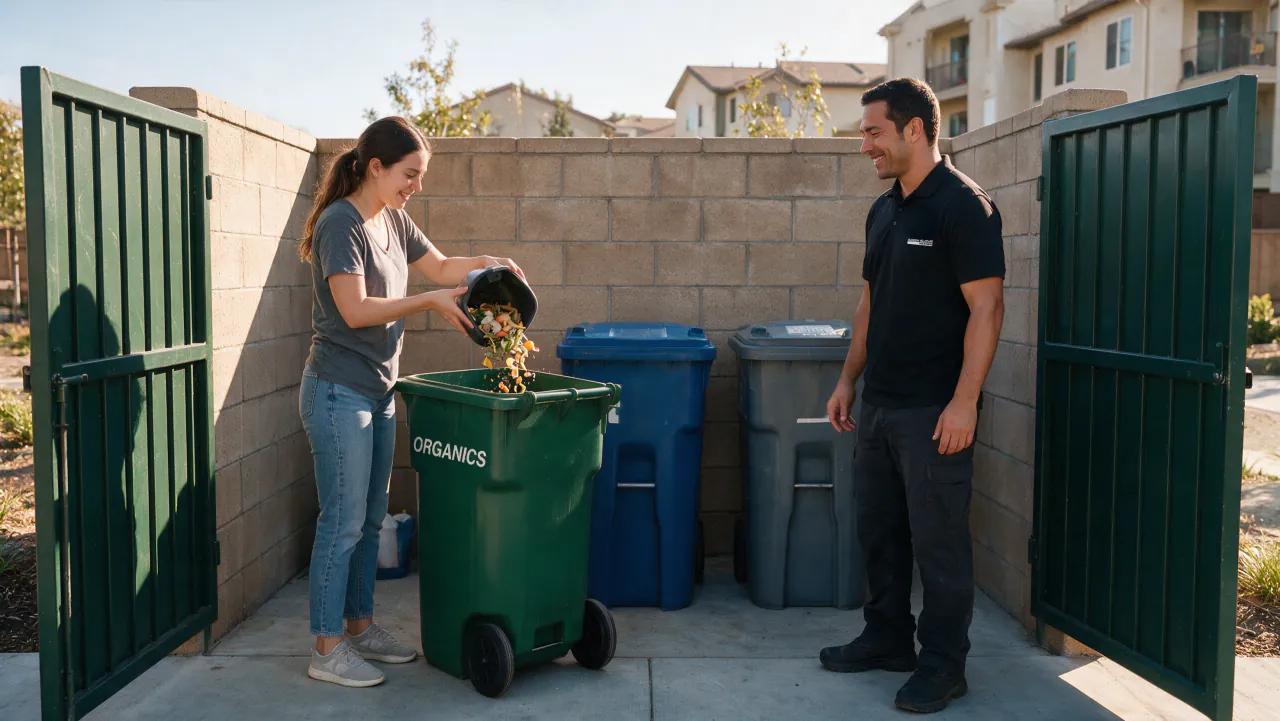
A resident emptying food scraps into an organics cart while a Green Glove Heroes crew member looks on

California's organic waste law in plain terms

SB 1383 is California's organic waste law. It requires multifamily properties to provide organics collection alongside trash and recycling, keep those streams free of contamination, and educate residents. The reporting is filed by the zero-waste expert at your hauler or county. Green Glove Heroes works directly with that expert, corrects issues on the property, and keeps your containers compliant six days a week at multifamily properties across Northern California.

What SB 1383 requires of your property

SB 1383 applies to multifamily complexes with five or more units. CalRecycle sets the rules and your city or county enforces them, and that enforcement is getting stricter every year. Here's what the regulation asks of you as the owner or manager:

  • Subscribe to your jurisdiction's organics collection, or self-haul organics to an approved facility, so every resident has organics service alongside trash and recycling.
  • Keep trash, recycling, and organics free of cross-contamination.
  • Give residents enough containers, sized and placed where they can use them, with the correct colors or labels. The standard colors are gray or black for trash, blue for recycling, and green for organics.
  • Teach every tenant how to sort at least once a year, as your jurisdiction requires.
  • Give new tenants that information within 14 days of moving in.

Your city or county can add its own rules on top of these, so read your local ordinance too. CalRecycle on SB 1383 ยท CalRecycle: multifamily requirements

How your property gets checked

Cities and counties had to start enforcing SB 1383 by January 1, 2024, and there are a few ways that enforcement reaches a multifamily property.

Annual compliance review. If your property has five or more units and produces 2 cubic yards or more of waste per week, your jurisdiction reviews it every year. Often that's a paper check that you have organics service.

Contamination checks. At least once a year, inspectors randomly inspect containers on your hauler's route. Separate waste evaluations sample the loads twice a year, and when a container type exceeds 25% contamination, the jurisdiction notifies and educates the properties on that route.

Notices and fines. For most other violations, the jurisdiction sends a Notice of Violation and gives you 60 days to fix it. After that, state base penalties are $50 to $100 for a first violation, $100 to $200 for a second violation within a year, and $250 to $500 for each subsequent violation. Your local ordinance sets the exact process. CalRecycle: jurisdiction enforcement

Our porters sort your streams by hand Sunday through Friday, with visit times set by routing and your property's needs, so contamination is pulled out before the truck comes.
A quick check you can run this week

Take this list along when you walk your trash areas. Anything you answer with a "no" or a "not sure" is where we'd start on a complimentary on-site visit.

  • Can residents in every building reach an organics container?
  • Are your containers the right colors, or clearly labeled?
  • When did tenants last get sorting information from you?
  • Did every new tenant this year get it within 14 days of moving in?
  • Open the organics bin the day before pickup. Do you see plastic bags, bottles, or cans?
  • Do you have every notice your hauler or city sent this year, and do you know which ones are closed?

Who does what

Your hauler provides the organics service and, with your county, files the reporting. Your city or county inspects and enforces. Your property is responsible for compliance on the ground. Green Glove Heroes is the on-the-ground part: sorting, correcting, labeling, documenting, and coordinating with the zero-waste expert who files.

Where compliance breaks down

A property can have organics service on paper and still be out of compliance every single day because residents put the wrong things in the wrong bins, and nobody corrects it before the truck arrives. Our porters attend training sessions conducted by Zero Waste specialists in every city we serve, and they sort your streams by hand, Sunday through Friday.

When you get flagged

When a notice comes in, we take over as the property's point of contact with the city or county. Our crew photographs the correction with the date on it, and we stay with the zero-waste expert until the issue is closed. City & county coordination

Staying compliant without over-serving

SB 1383 compliance does not require buying the largest organic service available. It means the right containers, sized to what's generated, kept clean. Custom Program Design

Case Studies

Client Success Stories

120+

Properties optimized

100%

Client satisfaction

3x

Average ROI

Case study · 65+ property affordable housing portfolio | North Bay, California

Turning around a 65-property affordable housing portfolio

A 65-property North Bay affordable housing portfolio runs monthly SB 1383 audits with us and reports a 4x return.

Read case study

4x

Portfolio ROI

Results vary by property.

Questions

Yes. Multifamily properties in California must provide organics collection alongside trash and recycling, keep the streams clean, and educate residents.

Organics collection for residents, streams free of contamination, resident education in the form required by the jurisdiction, and containers labeled and placed for compliance.

No, the zero-waste expert at your hauler or county files it, and we work with that expert while we correct issues on the property.

The property does, which is why our porters correct contamination before pickup six days a week.

We reset the streams, document the correction, and become your contact with the city or county until the notice is closed.

Yes, delivered by your city's or hauler's zero-waste coordinator using the jurisdiction's own materials. Training & Resident Support

Cities and counties had to begin enforcing by January 1, 2024.

State base penalties run $50 to $100 for a first violation, $100 to $200 for a second within a year, and $250 to $500 for each one after that. Most violations begin with a Notice of Violation and a 60-day compliance period. Your local ordinance sets the details.

It applies to multifamily complexes with five or more units.

New tenants need it within 14 days of moving in, and every tenant needs it at least once a year.

Not necessarily. What it takes is the right containers, sized to what the property generates and kept clean.

Heroic Waste Management → Made Easy

Ready to learn how we can turn your property into a top performer?