Heroic Waste Management → Made Easy
AI Smart Truck Fine Mitigation
Hauler trucks with AI cameras now score your containers at pickup. Our crews sort out contamination first and photograph every container to head off those fines.
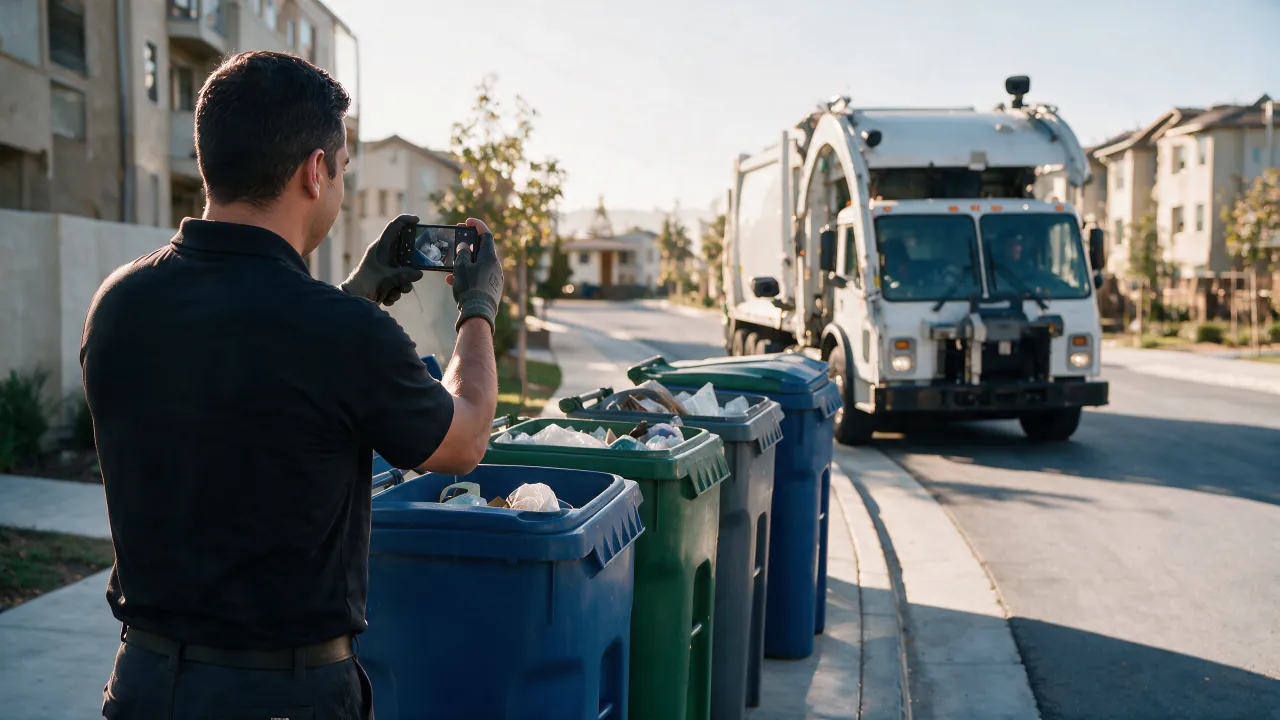
Clean containers before the camera sees them
More and more collection trucks carry cameras and AI that photograph your containers and score the contamination, and the charges show up without a person ever looking. Green Glove Heroes crews hand-sort every container at multifamily properties across Northern California before pickup, six days a week, and photograph it afterward. If a charge lands anyway, we dispute it with those photos.
What changed
Many haulers now use cameras and AI on their collection trucks to monitor your waste during pickup. One plastic bag in a recycling container can trigger a contamination fee, and a bag sticking up past the lid can bring an overage fee, all without anyone inspecting the container in person. The charge shows up on next month's bill, and the property usually finds out when accounting does.
This is enforcement that runs on its own. Contamination and overage penalties are becoming standard terms in hauler contracts and city ordinances, and every one comes with a video or photo to back it up. The properties that do well under it get ahead of the trucks. That means resident education and a trash area set up for how the cameras see it, plus a plan for the charges before they show up. We'll walk through what smart trucks are, why haulers adopted them, and what you can do about them.
Why haulers put cameras on trucks
California's SB 1383 was signed in September 2016, and it's a big part of the state's climate plan. It goes after short-lived climate pollutants, methane most of all, because methane is a potent greenhouse gas and organic waste in landfills produces about 20% of the state's methane emissions. The law set statewide targets to cut landfilled organic waste 50% by 2020 and 75% by 2025. To show progress, cities and counties need proof of what's in the containers, and haulers, led by Waste Management (WM) and Recology, are supplying that proof with smart trucks.
Those trucks carry cameras, GPS, AI, and sensors, which haulers bought mainly so they could run their routes more efficiently and meet state diversion goals. The same footage moves accountability for sorting and container use from the hauler over to the property owner and manager.
The law also imposes direct obligations on businesses, and under SB 1383, a multifamily property with five or more units is considered a business. Property managers have to:
- Provide or arrange organics collection for all tenants and employees.
- Supply enough correctly colored and labeled containers: gray or black for trash, blue for recycling, and green for organics.
- Place those containers in every area with disposal containers, except restrooms.
- Educate employees and tenants on sorting every year, and provide new tenants with this information within 14 days of moving in.
- Inspect organics containers periodically and tell tenants when there's contamination.
Cities and counties enforce these rules, with civil penalties that run from $50 to $500 per violation. A jurisdiction can contract with a hauler to run route reviews and send warnings, and even then the authority to impose civil penalties stays with the jurisdiction. CalRecycle: jurisdiction enforcement
How the Technology Works
Smart Trucks 101
A smart truck is a collection vehicle that's wired into a connected system, and two parts of that system matter to a property manager.
- Onboard computers and fleet software: tablets in the cab handle route optimization, real-time directions, and digital route sheets, so drivers no longer work from paper. They talk to dispatch and the hauler's back-office software.
- Onboard cameras: a network of cameras provides the driver with a 360-degree view, enhancing safety and recording each collection. Paired with GPS, that footage documents service, flags overfilled containers, and catches contamination. WM's Smart Truck® system, for example, records each container as it's tipped into the truck.
Together they make a feedback loop that runs from your containers straight to your bill. The cameras started as a back-office tool for the hauler. Today the footage they record is how contamination charges get written, with data to back each one up, and the responsibility for sorting sits with the property.
So you need a process that keeps containers compliant before pickup, plus an expert to audit the hauler's data so you aren't paying for charges that aren't yours.
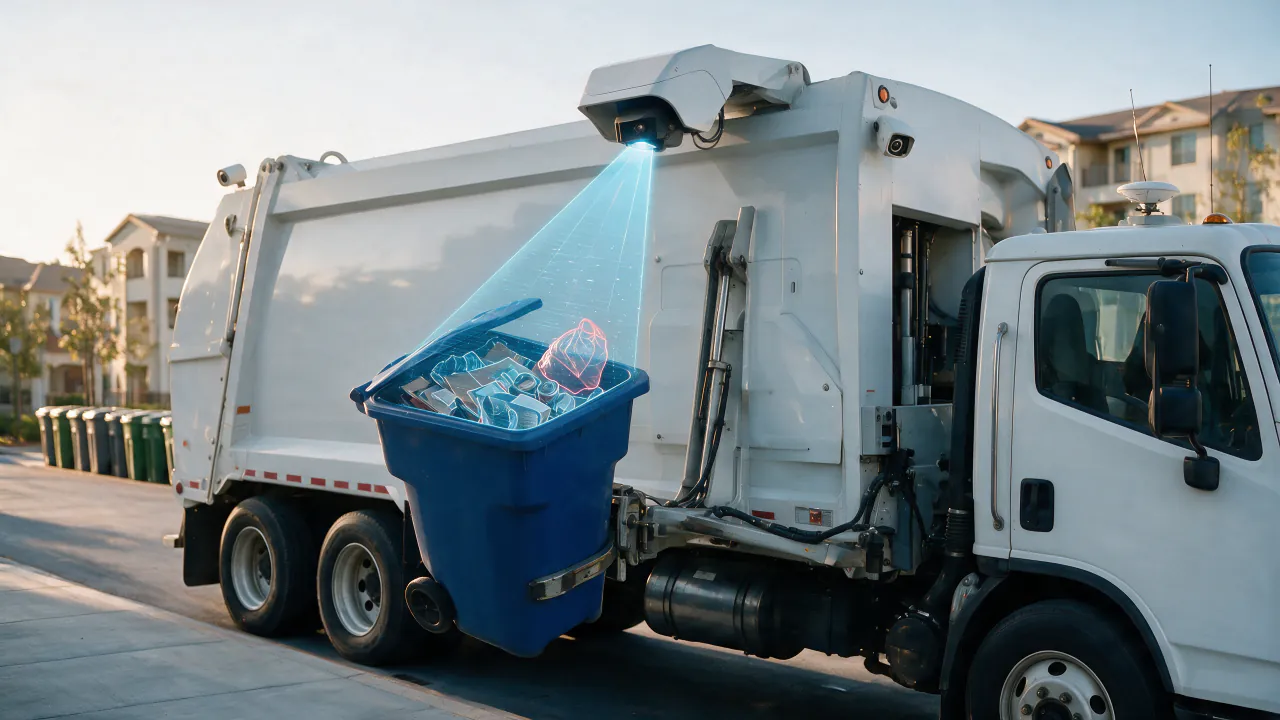
Where the system gets it wrong
The data isn't perfect, so someone has to check it before you pay.
- GPS mix-ups: footage gets tagged to an address by GPS, and for many of our clients who sit next door to other properties, GPS errors have put a neighbor's penalties on the wrong bill.
- Blocked cameras: dirt, debris, and bad weather can cover cameras and sensors. The AI can also misread a container, especially one from a neighborhood or waste mix it wasn't trained on, and that leads to uneven enforcement from one property to the next. The whole system is only as good as the data going in.
- Disconnected data: GPS, camera footage, and the hauler's back-office software often live in separate systems that don't always align. In the worst case, that means an incorrect charge or a poor service record.
- No common standard: this data has no statewide platform. Haulers and cities each run their own systems, which makes performance hard to compare, and the way you dispute a violation changes from one jurisdiction to the next.
A clean container before the truck arrives
As soon as the camera takes its photo, the fee is on its way, so your defense is a clean container at pickup and a dated photo of your own proving it was clean. Our porters are on your property Sunday through Friday pulling contamination and overage before pickup, and they photograph every container while they're at it. When a charge lands anyway, your Hauler Advocate sends it back with that evidence, which gives the hauler a documented reason to reverse it. Hauler Advocate Services
Compactors hide contamination
A compactor takes everything, compresses it, and shows the camera one thing: contaminated trash. Properties with compactors are flagged more often, and there's nothing to sort. Compactor Maintenance covers when a compactor is costing more than it saves.
Fix what keeps getting flagged
If the same container gets flagged every week, it's a placement, signage, or education problem. We fix those too. Waste Stream Separation · Training
What to ask your hauler
When you negotiate a new or renewed contract, finding out how open the hauler is with its data is part of your due diligence now, so ask your hauler:
- What its trucks record at your property, and what data and reporting you'll get from it.
- How it enforces contamination and overage charges.
Waste management in California keeps getting more complicated, and more of the responsibility lands on property managers every year. Staying ahead of it keeps the fees off your bill and shows owners and residents that the property is well-run and compliant. It also belongs in the property's sustainability and ESG (environmental, social, and governance) strategy. A partner on-site every day makes all of that easier to carry. Contact us and let's get ahead of these charges before they cost you a fortune.
Questions
It's a fee that gets added automatically when the hauler's onboard camera detects the wrong material in a container, such as a plastic bag in recycling, or a bag over the rim, and no person ever inspects it.
Yes, with evidence. A dated photo of a clean container before pickup gives you the strongest case to get the fee reversed. Without one, the hauler's photo usually stands.
Hand sorting and correction of every container before pickup, photographed, six days a week. Charges that still land are disputed by your Hauler Advocate with that record.
Placement, signage, or education. Usually the container residents reach first is the one that gets the wrong bags. We fix the layout and coordinate training.
SB 1383 requires cities and counties to cut the organic waste going into landfills and to prove they've done it. The cameras and GPS on a truck give the hauler a record of every container, and that same footage is what the hauler uses to write contamination and overage charges.
Yes. Footage is tagged to an address via GPS, and properties next door to each other can pick up each other's charges. Dated photos of your own containers are how you challenge it.
Yes. A compactor presses everything into one stream that the camera reads as contaminated, which leaves nothing to sort before pickup.
Heroic Waste Management → Made Easy