
The Era Of Passive Waste Service Is Over
With the launch of smart trucks in Northern California, the era of passive waste service is over. Previously, the consequences of improper sorting or overfilled bins were often handled reactively. Now, enforcement is proactive, data-driven, and verifiable through video and photographic evidence. Penalties for non-compliance are becoming standardized and are now an explicit part of hauler contracts and municipal ordinances. A property manager’s success in this new environment will be defined by their ability to transition from reactive problem-solving to proactive, data-informed compliance management. This requires a strategic shift in focus toward tenant education, optimizing waste infrastructure, and proactively managing and planning how to mitigate the new risks smart trucks and other technologies bring into the picture. That is where we help our clients thrive and optimize their KPIs. Let’s look at what smart truck are, why they were brought in, and what you can do about it.
The landscape of waste management in Northern California is undergoing a fundamental transformation, driven by a convergence of ambitious climate legislation and sophisticated digital technology. Waste haulers, led by industry leaders such as Waste Management (WM) and Recology, are rapidly deploying “smart trucks”—vehicles equipped with a suite of integrated technologies, including onboard cameras, GPS, artificial intelligence (AI), and sensors. While these innovations are primarily designed to help haulers meet operational efficiency and state-level diversion goals, they have a profound and direct impact on property managers. The adoption of this technology creates a new, digital feedback loop, effectively transferring accountability for waste sorting and container usage from the hauler to the property owner and manager.
The widespread adoption of smart truck technology is not an isolated phenomenon but rather a direct and necessary response to a complex regulatory and economic environment. Let’s look at California’s SB 1383.
A Deeper Look into California’s SB 1383
The primary catalyst for the digital revolution in waste collection is California’s Senate Bill (SB) 1383. Enacted in September 2016, this law is a critical component of the state’s broader effort to combat climate change by targeting short-lived climate pollutants (SLCPs), particularly methane. Methane is a potent greenhouse gas, and organic waste in landfills accounts for approximately 20% of the state’s total methane emissions. To address this, SB 1383 sets aggressive statewide targets: a 50% reduction in landfill-disposed organic waste by 2020 and a 75% reduction by 2025.
The law places specific, non-negotiable obligations on multi-family residential properties and commercial businesses.
Property managers are required to:
- Provide or arrange for organic waste collection services for all tenants, employees, and customers.
- Ensure there are an adequate number of correctly colored and labeled containers. The standardized color scheme mandates grey or black for trash, blue for recycling, and green for organics.
- Provide access to these containers and ensure they are placed in all areas with disposal containers, with the exception of restrooms.
- Annually educate employees and tenants on proper waste sorting practices and provide information to new tenants within 14 days of occupation.
- Periodically inspect organic waste containers for contamination and provide feedback to tenants if issues are found.
Compliance with these mandates is overseen by local jurisdictions (cities and counties). These jurisdictions are empowered to enforce the regulations and can impose civil penalties for non-compliance, which can range from $50 to $500 for a single violation. A critical legal distinction exists: while a jurisdiction can contract with a hauler to perform monitoring and provide warnings. The mandate for verifiable compliance with SB 1383 is the key market force driving waste haulers to adopt new technologies that can systematically and reliably monitor customer behavior at a granular level.
What is a “Smart Truck”?
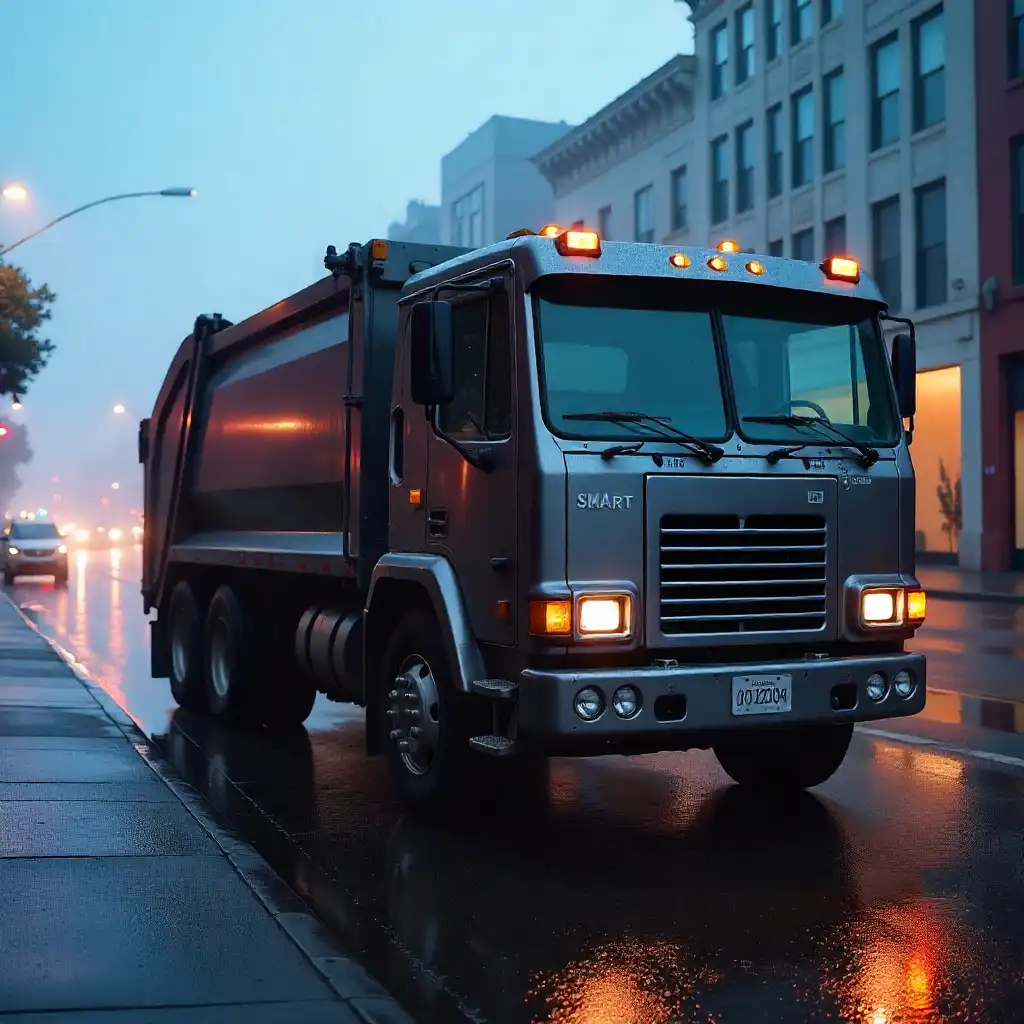
In response to the regulatory pressure and the need for greater operational efficiency, waste haulers have developed and deployed a new generation of collection vehicles. The term “smart truck” refers to a vehicle that integrates a variety of digital technologies to create a connected, intelligent system. The core components of these trucks include:
- Onboard Computers and Fleet Management Software: Tablets and computers in the cab provide drivers with dynamic route optimization, real-time directions, and digital routesheets, eliminating the need for paper-based systems. These systems also communicate with central dispatch and back-office software to streamline operations.
- Onboard Cameras: A network of cameras provides 360-degree visibility, improving driver safety and enabling the recording of the collection process. This footage, in conjunction with GPS, is the primary tool for documenting and verifying service, identifying overfilled containers, and flagging contamination. Waste Management, for example, uses its WM Smart Truck® technology to capture footage of containers as they are tipped into the truck.
The transition to smart trucks fundamentally alters the relationship between property managers and their waste haulers. The technology, which was once a back-office tool for the hauler, has created a transparent and unforgiving digital feedback loop that directly impacts the property manager’s bottom line.
The Digital Feedback Loop: From Your Bins to Your Bills
The enforcement of waste sorting and overage rules is no longer based on a driver’s visual check or a complaint. The process is now systematized, digital, and data-backed. And you need to ensure that you have the right processes in place to first ensure compliance, but then you also need the expertise to audit the data and ensure you are not being assessed for incorrect penalties.
- Collection and Capture: As a smart truck services a property, its cameras capture footage of the container as it is being emptied. This footage is automatically tagged with the service address via GPS. For many of our clients, this has become an issue, especially with nearby properties and the inaccuracy of the GPS tools. Leading to issues such as penalties to adjoining properties being assessed to the wrong property.
- Sensor and Camera Reliability: The technology itself is not immune to real-world challenges. Onboard cameras and sensors can be obscured by dirt, debris, or poor weather conditions. The AI that processes the captured data can also be subject to errors and biases. An AI system trained on data from one type of neighborhood or waste composition may be less accurate when operating in another, potentially leading to inconsistent or unfair enforcement. The integrity of the entire system depends on the quality and consistency of its input data.
- Data Fragmentation: A core challenge is the fragmentation and disconnection of the various data systems involved. Data from a truck’s GPS, its cameras, and the hauler’s back-office software may not always be seamlessly integrated, creating “data silos” that hinder a holistic analysis. This can lead to a disjointed system that, in a worst-case scenario, results in incorrect billing or service verification.
- Lack of Standardization: The lack of a unified global or even statewide platform for data sharing and analysis means that different haulers and municipalities may use different systems, making it difficult to compare performance or dispute a violation across jurisdictions. The complexity of the waste problem, which involves diverse stakeholders from citizens to policymakers, requires a comprehensive approach to data and management that is still in development.
What Can You Do?
Waste Management in California, as you can see and have experienced, is only getting more and more complicated. Every day, more and more of the responsibility is shifting to the property managers. Managing this new system effectively is not just about avoiding fines; it’s about positioning a property as a responsible, modern, and compliant asset. When negotiating new or renewed service contracts, property managers should inquire about the hauler’s specific technology, enforcement protocols, and the level of data and reporting provided. A hauler’s ability to provide transparent, data-driven service is now a critical part of the due diligence process.
That is why, having the right partner, like Green Glove Heroes, to provide you with proactive waste management is no longer an optional core part of your property’s overall sustainability and ESG (Environmental, Social, and Governance) strategy – it is a necessity. Together, let us meet these new risks and tackle them before they cost you a fortune. Contact us today to solve your waste management issues heroically today and for the future.
*Citations & References available upon request.